
Have you ever noticed that in any high density area, women are seen to queue endlessly for the toilet as men happily skip past into the ever revolving door of penis-only water closets?
It’s because architecture has been dominated and developed by men for as long as it’s existed, who through equality give the same amount of space for both genders bathrooms, ignoring that fact that one user requires more space than the other, in its majority. The equality of the two spaces creates an inequality for women dependant on their needs, whereas they should instead have equity on the peeing space required.
Design as it stands – and as it always has – is male dominated which gives it little room for female empathy; even if it is a rather inclusive industry. If only I had to reference the toilet analogy to make my case, it proves horribly sharp that our most permanent and sizeable design output – public architecture – have a distinct lack of empathy for women; or rather anyone non-male.
It’s a enormous pointing hand, illuminating a bright sign of ignorance that a public space incentivised for use by all is created without thought for the needs of all its users. It is correct that men and women hold of the same amount of possible space for releasing pent up excrement, but any women who’s found herself queueing upon a full bladder could tell you that equal space is not equal representation.
Clearly design hasn’t as much care for females as it does males, but what if you do not assign to a binary gender? – then standard public architecture doesn’t so much hinder you, but ignore you completely. Kate Moross is one said person who does not align with being male or female, but is also a prolific designer, now running and directing Studio Moross.
Kate has been outspoken about working to create empathy and power for those that find themselves in the trenches of design apathy—in an interview with It’s Nice That Kate describes her working situation as “I’m constantly battling peoples and businesses who don’t have a third or fourth or fifth box for when you sign up for something and have to enter your gender.” which is a situation I can’t image many designers would often consider, never mind the masses of male creatives that have never been confronted with the issue of not being able to find their gender on any given form.
Clearly, for Captain Moross making these small changes such as including the fifth gender box are a personal battle being fought for the masses of the hegemonically ignored, explaining in said interview “That’s something of a small battle I’m fighting every day”. This may seem like a non-issue for many, but I can imagine that for the people it concerns it’s a courageous, empathetic fight.
It’s hard for me to understand the relevance of it, being that I fall into the category of your ‘average designer’ in many, many ways; but I know if I tried to do something as simple as sign a form and it didn’t allow for my full address that would drive me nuts, never mind trying to describe my identity from a selection of two inaccurate drop-downs.
Just as peoples gender can be thrown onto the pile of ignored needs, so can disabilities. Though we see around us – in developed nations at least – building being developed and adapted to allow access to those operating wheelchairs and other mobility devices, we see the same thoughtfulness completely lost for those without obvious physical disabilities.
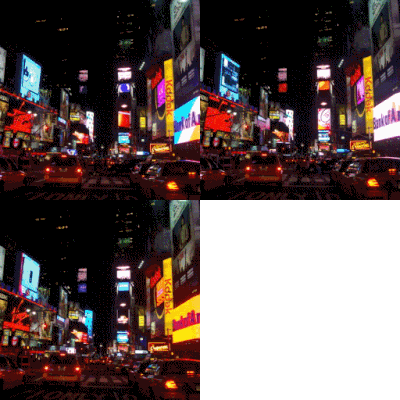
Though it may seem a far-fetched point, the cities and spaces we live in can be minefields for people with disabilities, one such being those on the autistic spectrum and the over-stimuli they face day to day. We as designers spend all our days making the most visually exciting, eye-grabbing material for our clients but when they put them up on billboards, here, there and everywhere it makes life difficult for those who find them offensive. Though the problem lies with the imagery designed, it’s the companies and councils planning and designing their cities in a hodge-podge fashion of capitalistic sprawl that makes lives for those with who suffer, a confusing, stress inducing experience.
If you look at the title, you’ll see me telling design that it needs more empathy but design is not a single person, blue in the face guilty of it’s injustices; it is in fact an entity build upon a community of people. People need more empathy. People need more empathy, in their design.
I too have lead you down a path of ignorance, I am not the great source of empathy that I may seem. I thought not of the people with dyslexia when I made huge bright yellow posters and I disregarded the needs of the people with poor sight when I refused to add alt tags to my posts, in an effort to save myself time. The empathy we need is the empathy to consider the users and decoders of the work we create, not just the client that it is being created for.
The fact is it’s much easier to point the finger than solve the problem, rather unsurprisingly. But should you be aware that something you are creating would be accessed and used by anyone in particular, give the women some more space to pee, understand that not everyone defines their sexuality as easily as an online clothes retailer and if all else fails, see our governments resources available on designing for accessibility.
Disclaimer: I am no expert of disabilities or women, if I’m miles off the mark with my observations please tell me, or lock me in the stocks and throw tomatoes at my ignorant noggin—either will do.
